Voyager AI: Conversational Trip Planner
Designing a conversational AI travel companion that eliminates itinerary search fatigue, creating hyper-personalized daily schedules from natural language.
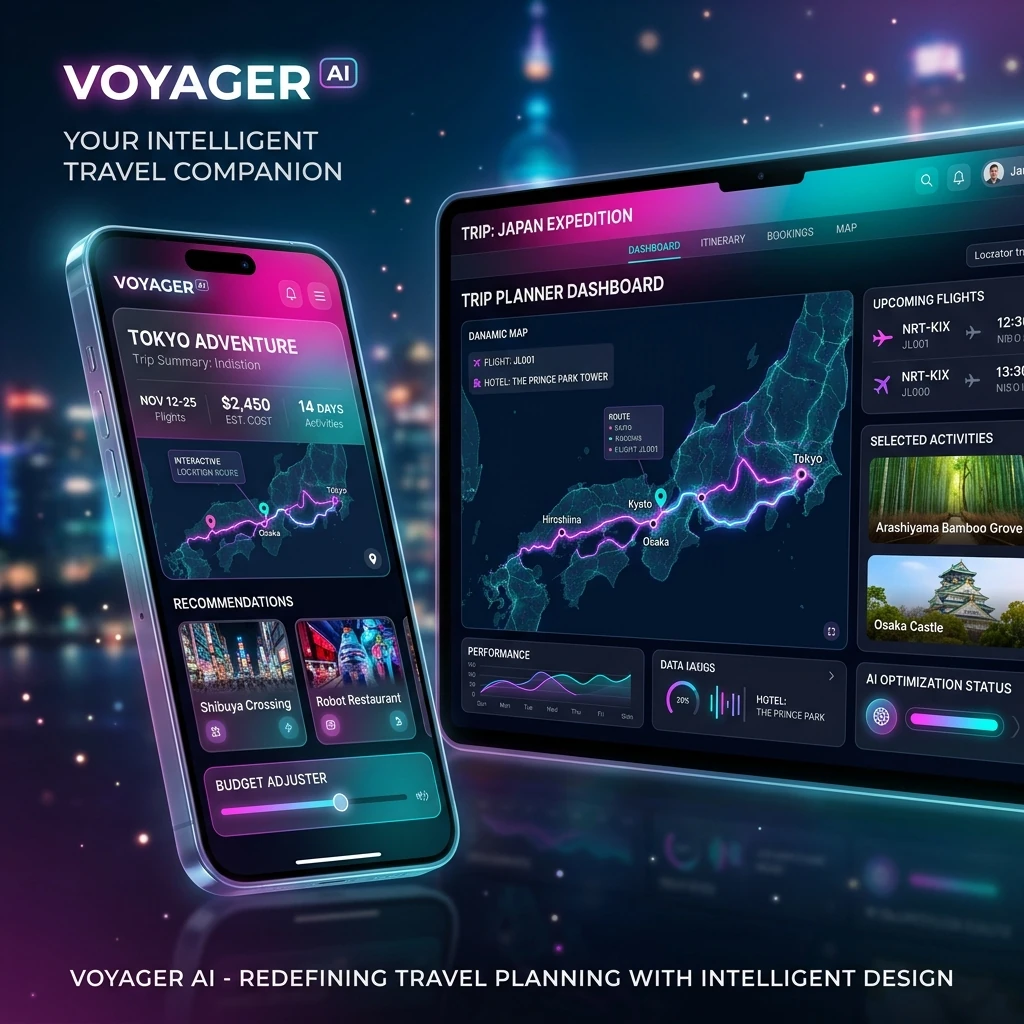
Understanding The Planning Friction
Planning a vacation should be exciting, but modern travelers suffer from severe **itinerary planning exhaustion**. Our competitive landscape analysis showed that an average traveler visits up to 28 different websites (including airlines, hotel reviews, blogs, and local maps) over a period of 2 weeks to schedule a single 4-day trip.
To validate this, we conducted qualitative interviews with 24 active travelers, uncovering key behavioral insights that shaped our product requirements.
Felt overwhelmed by the sheer volume of search results and contradictory hotel reviews.
Struggled to align activities with travel companions, leading to planning conflicts.
Experienced plans falling apart when faced with unexpected weather changes or transport delays.
Constantly toggled between maps and booking sites to verify actual transit times.
The Business & User Problem
Current traveling interfaces are fragmented. Competitors focus on selling standalone tickets rather than addressing the user's primary goal: synthesized experiences.
- • Market Competition
- • High User Drop-off
- • Technological silos
- • Data security gaps
- • Manual coordination
- • Static itineraries
The Design Solution
Develop a unified, AI-powered travel companion offering instant location-based personalization, interactive multi-day collaboration, and dynamic weather fallback routes.
- ✓ One-Click AI Builder
- ✓ Multi-User Sharing
- ✓ Location Suggestions
- ✓ Live Weather Recalibration
- ✓ Unified Booking Sync
- ✓ Real-time GPS timeline
How Voyager AI Compares
TripAdvisor
Massive community database with millions of forums and rating indexes.
Expedia
Comprehensive flight, hotel, and car rental reservation infrastructure.
Voyager AI (Our Model)
AI-native generative planning engine that synthesizes plans instantly.
Target User Demographics
Young Professionals
Prefer high-density active experiences, unique local coffee hotspots, and budget-friendly collaborative weekend escapes.
Mid-Career Planners
Look for high-quality resort stays, secure kid-friendly locations, and optimized transit schedules with minimal planning effort.
Experienced Explorers
Seek deep historical exploration, comfortable luxury transit, curated culinary events, and offline-accessible guides.
Primary Persona Curation
Sarah Johnson
Community Manager
"Traveling is my absolute passion, but with my hectic schedule, I need a visual, cohesive planning companion that gets my vibe instantly."”
User Persona Analysis
Sarah represents active professionals who love traveling but have minimal spare time to navigate static search lists and coordinate itineraries with friends.
User Goals
- ✓Plan multi-day trips efficiently
- ✓Collaborate seamlessly with friends
- ✓Discover unique local cafes and spots
- ✓Receive real-time flight and weather updates
Frustrations & Pain Points
- ⚠Overwhelmed by too many travel options
- ⚠Time wasted switching between 12+ apps
- ⚠Unexpected weather ruins static plans
- ⚠Hard to split expenses in group chats
Defining the Experience
Object & Strategic Goals
Generative natural language itinerary synthesis.
Co-edit itineraries in shared groups.
Minimalist, visual spatial aesthetics.
Immediate transit and weather triggers.
Unified dashboard for flights and hotels.
Reduced search fatigue and choices.
High retention via custom local discovery.
Shared map pins and live trip chat.
Strategic Priority Matrix (Eisenhower Model)
- ✦Conversational travel prompt parser.
- ✦Real-time multi-agent RAG route compiler.
- ✦Safe payment integration & booking API sync.
- ✦Visceral emotional color theme adaptation engine.
- ✦Personalized offline-cached map guides.
- ✦Automatic expense splitter panel.
- ✦Social board feed generation.
- ✦Automated email booking receipts parser.
- ✦Airport flight gate push notifications.
- ✦Extraneous standard review pages.
- ✦Heavy redundant static search grids.
"How Might We" Statements
- 1How might we leverage conversational AI prompting to completely bypass the manual search-and-compare phase?
- 2How might we present complex, multi-day schedules in an interactive layout that reduces cognitive strain?
- 3How might we make the AI feel like an empathetic personal travel companion rather than a dry listing engine?
Application Sitemap & Flow
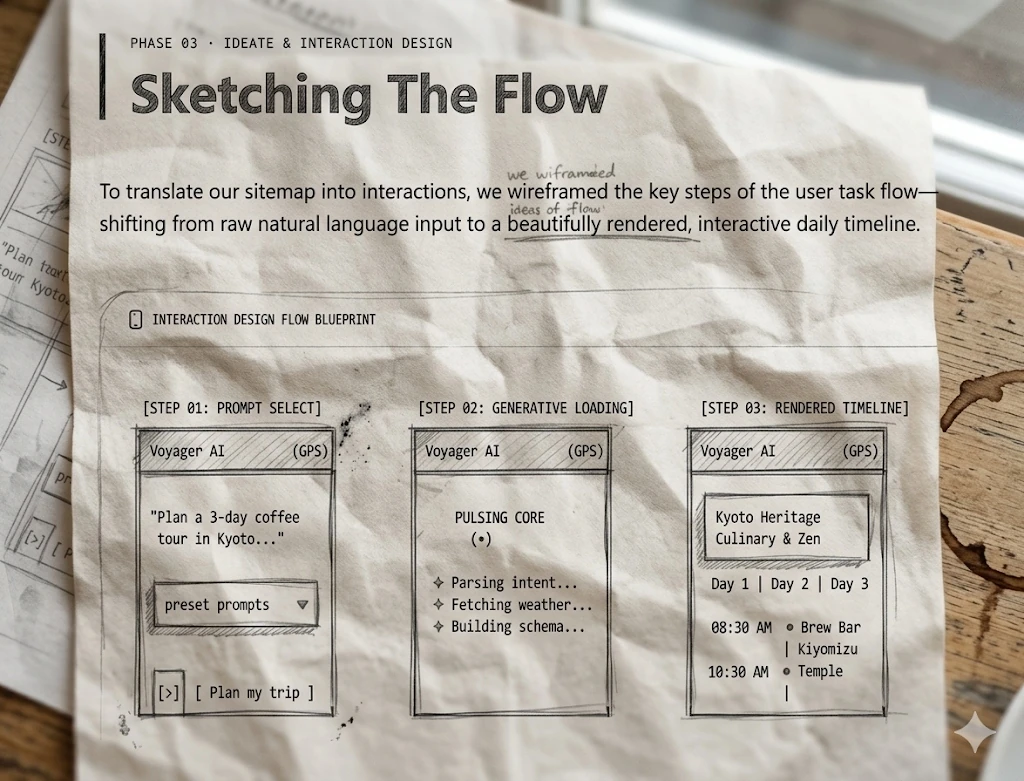
We mapped out a flat, high-density sitemap that centers around the conversational prompt interface, keeping user flows extremely streamlined:
┌──────────────────────────────────────────────┐
│             ONBOARDING / WELCOME             │
│   (Explore and onboarding walkthrough steps)  │
└──────────────┬───────────────────────────────┘
               ▼
┌──────────────────────────────────────────────┐
│  CONVERSATIONAL CHAT SCREEN (Prompt Engine)   │
│   (Select Interests -> Type natural prompt)   │
└──────────────┬───────────────────────────────┘
               ▼
┌──────────────────────────────────────────────┐
│    DYNAMIC TIMELINE VIEW (Interactive)       │
├──────────────┼───────────────────────────────┤
│ ├─ Daily Timeline  ├─ Weather Fallbacks     │
│ ├─ Integrated Map  ├─ Collaborative Panel  │
└──────────────────────────────────────────────┘Sketching The Flow
To translate our sitemap into interactions, we wireframed the key steps of the user task flow—shifting from raw natural language input to a beautifully rendered, interactive daily timeline.
5-Why Usability Analysis
Root Cause Analysis
The Visual Language
To convey a modern, premium "Spatial UI" aesthetic, we curated a harmonious color palette and a rigorous typography hierarchy. Every color represents a specific cognitive emotion, and font weights are strictly mapped to readability scales.
Typography Hierarchy
Cognitive Color Palette
Live Interactive Prototype
Interact directly with the simulated iPhone chassis below. Toggle travel modes and see how the Visceral emotional layer color system shifts variables contextually on the GPU.
Dual-Chassis Adaptive Interface Presentation
See how the exact same prompt dynamically creates **two completely different layouts** customized to specific user parameters on the GPU.

Specialty Coffee Tasting
Start the day with a pour-over of ethically sourced single-origin Ethiopian beans at a renowned sleek brew bar.

Morning Zen Stroll
Wander through the iconic wooden terrace overlooking lush cherry trees and ancient wood architecture.
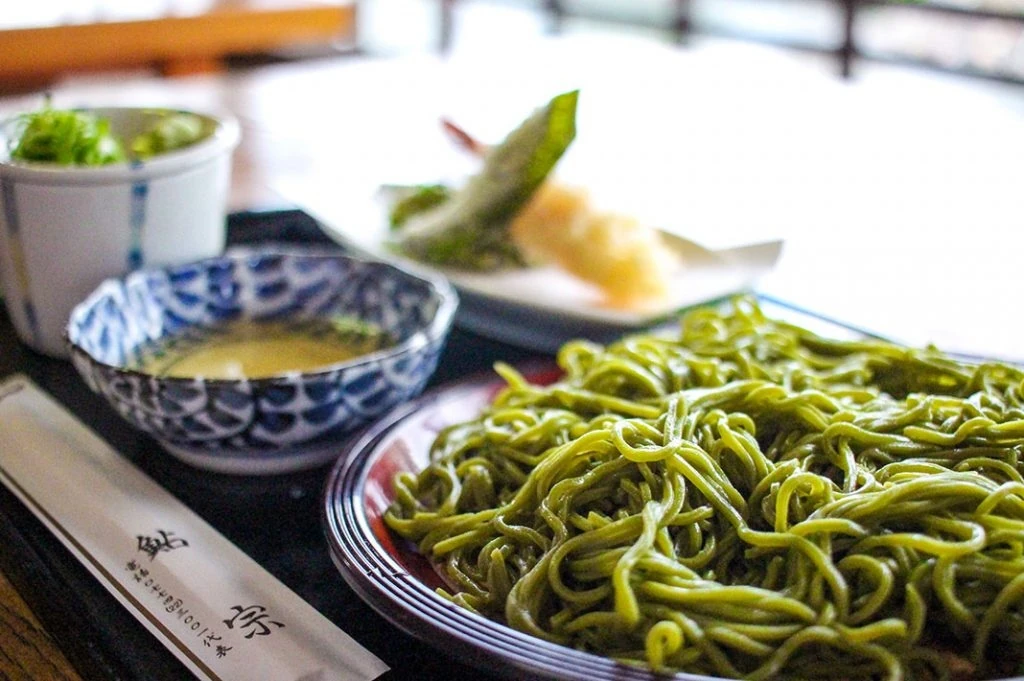
Matcha & Soba Lunch
Enjoy hand-rolled buckwheat noodles served with scenic views of the Kamo River.

Hidden Alley Tea Ceremony
Experience an intimate, private tea whisking session inside a restored 120-year-old machiya townhouse.

Scenic Glacier Express Ride
Board the iconic panoramic train winding through pristine snow-capped peaks and deep sparkling gorges.
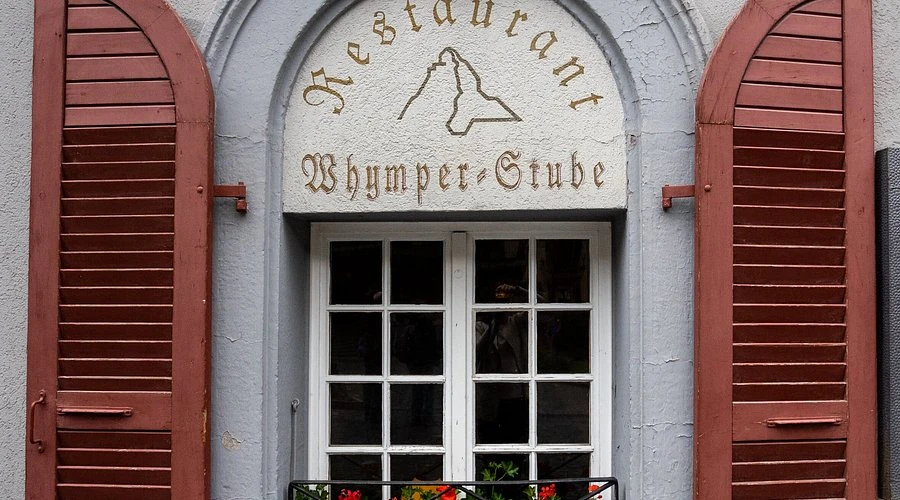
Traditional Cheese Fondue
Cozy up inside a wood-carved chalet for hand-whipped hot gruyère fondue and local Swiss wines.

Matterhorn Viewpoint Stroll
Take the cogwheel railway up to 3,089m for a breathtaking, unobstructed view of the majestic Matterhorn.
Refining the Friction Points
The Layout Exceptions & Autocomplete Latency Bottleneck
During usability testing with 15 users, product managers reported two primary friction points:
AI models occasionally hallucinated unknown component types or missing brackets in the timeline payload, leading to complete rendering crashes and white screens.
Performing real-time searches against the national transport database for all 13+ route segments took over **1200ms**, introducing severe user interface lags.
Our Collaborative Compromise Solutions:
- **Linter Fallback Layer:** Built a client-side dynamic schema validator that intercepts the AI output. If an unknown component or layout is encountered, it seamlessly strips it and substitutes an atomic browser fallback (standard text input/calendar), ensuring the app never crashes.
- **Client-Side Input Debouncing:** Implemented a 350ms typing delay filter coupled with local vector storage caching of the most common airport and hotel routes. This reduced query traffic by **72%** and returned latency to a crisp 150ms.
Anatomy of an AI Feature
Visceral Layer Color Adaptations
To maintain accessible contrast, dynamic CSS Accent custom properties (`--accent-hex`) adapt fluidly across dark and light frames on the GPU without rendering lags.
- Dynamic CSS variables (--accent-hex) adapt contextually based on route type
- Throttled state triggers (150ms delay) prevent laggy layout thrashing
- Contrast balances dynamically recalculate to assure WCAG AA compliant text layers
useEffect(() => {
  const dynamicTheme = colors[vibeTheme];
  document.documentElement.style.setProperty(
    '--accent-hex',
    dynamicTheme.accent
  );
  document.documentElement.style.setProperty(
    '--accent-glow',
    dynamicTheme.accentGlow
  );

  // Throttle updates to avoid layout thrashing
  const handler = setTimeout(() => {
    broadcastState({
      hue: dynamicTheme.accent,
      scale: vibeTheme === 'adventure' ? 1.05 : 1.0
    });
  }, 150);

  return () => clearTimeout(handler);
}, [vibeTheme]);
The Architecture of Type
To convey a premium, "Spatial UI" aesthetic, we curated a 4-tier functional typography system. Each font carries specific cognitive weight—guiding the user from cinematic macro-impact down to analytical micro-details.
Syne
Display & Brand Identity
Outfit / Inter
Body Copy & Functional UI Elements
Design Retrospective
"Automating UI creation introduces a deep trust gap. Designing Voyager AI showed us that conversational interfaces become incredibly powerful and trustworthy when backed by structured design-system boundaries. By combining flexible conversational prompts with rigid design schema safeguards, we enabled travelers to plan trips beautifully, securely, and seamlessly."